Field Path or Lane: Reading Two Ways Across the Countryside
Learn to tell a field path from a lane by reading its surface, width and enclosure, then choose a route that suits your walk and the ground.

Is that narrow way across the countryside a field path or a lane? To tell a field path from a lane, look at how its surface, width and boundaries work together. Grass may cover an old track, while a broad path can look almost road-like.
Surface clues
A field path usually follows the ground rather than presenting a deliberately built surface. It may be trampled soil, short grass or a faint line between crops. Rain, seasonal growth and regular use can all change how clearly it shows.
A lane more often has a continuous surface suited to repeated passage. Look for compacted gravel, broken stone, tarmac or a hard central strip with softer margins. It need not be neatly paved: even a rough or leaf-covered lane may keep a recognisable shape.
Surface alone can mislead. A field path may cross a short hard stretch near a farm, while a quiet lane may be grassy where vehicles rarely pass. Follow the route for a little distance. Does the firm ground continue between boundaries, or stop where the path meets a gate?
Width and passage
A field path is often just broad enough for walkers to pass carefully. It may narrow at a stile, bend around a tree or disappear briefly among tall grass.
A lane tends to leave more room for people, carts or farm vehicles. Its width may vary, but the sides often form a clear corridor. Ditches, hedges, walls or banks can help trace it when the middle is overgrown.
Width is not decisive. A broad strip through a field might be a farm access track, while an old lane can pinch between buildings or hedges. Read the whole stretch: a continuous corridor suggests a different kind of passage from a narrow line wandering across a field.
Boundaries and views
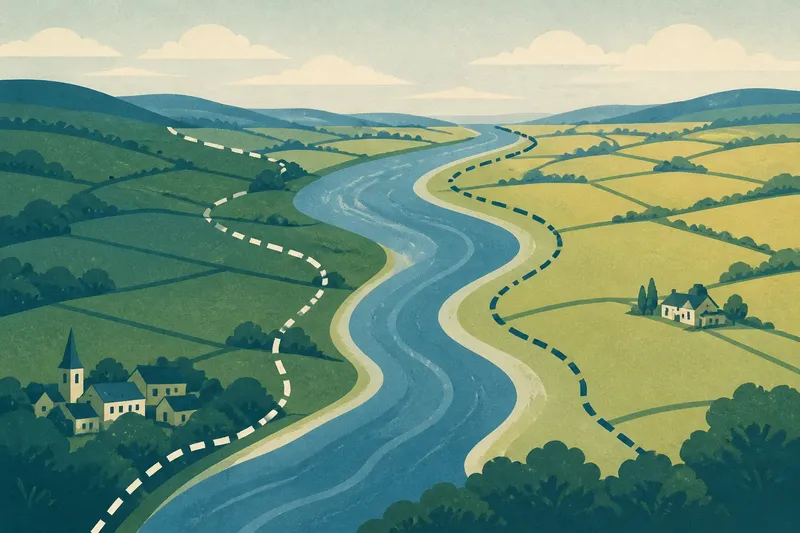
Field paths often feel open because they cross the working landscape. A hedge might border one side, with crops or pasture on the other, but the route may not form a deep corridor. Gates, field corners or a visible destination can make its direction clear.
Lanes commonly have stronger enclosure. Tall hedges, banks, stone walls, fences or buildings can channel the view and make the route feel like a passage between places. Some are shaded tunnels; others open suddenly onto a field or village. These edges help distinguish a lane even when its surface is packed earth.
Boundaries also shape the walk. A field path invites you to look outward at crops, slopes and distant landmarks. A lane tends to draw your eye along its length, towards a bend, gate or cluster of buildings.
Choosing a route
Think about the walk you want. A field path may suit a route linking fields, opening up views or crossing a farmed landscape. A lane may feel more comfortable if you want a firm, continuous surface or a clear passage between farms and settlements.
Neither is automatically easier. Mud can slow you on a path; a lane may carry vehicles or leave little room to step aside. Consider the weather, visibility, footwear and public access. Check a current local map and signs at the entrance: appearance alone does not establish who may use a route.
Say you are choosing between a narrow grass track across pasture and a gravel lane curving behind a hedge. You want open views, but recent rain has left the pasture soft. If the map marks the grass track as accessible, choose it only if you are comfortable with muddy ground; otherwise, take the lane if its access and traffic conditions suit you. The observable trade-off is a more open view against a firmer, more enclosed walk.
When clues conflict?
Why can a path look like a lane?
Repeated use can press a field path into a broad, hard strip, especially near a gate or farm entrance. Check whether the firm surface continues as an enclosed corridor or fades into a narrow line across the field.
Can a lane be grassy?
Yes. A little-used lane may grow grass, gather leaves or lose the crisp edges of a maintained track. Look for a consistent route between boundaries and a width that continues beyond the grassy patch.
What if the route disappears?
Crops, long grass or mud can hide a path. Pause to check the map, signs and the line of gates or field edges; do not cut across planted ground while searching for it.
Does a stile identify the route?
A stile suggests that walkers may be expected to cross a boundary, but it does not identify the route or establish access rights by itself. Follow the mapped line and posted signs rather than treating one feature as decisive.
Reading the whole route
It is not worth forcing a perfect label onto every stretch. Tracks change character, and one route can shift from hard lane to grassy path and back again. A short look along its course is more useful than judging it from one patch of ground.
For reading countryside landscapes, the practical distinction is simple: a field path tends to form a lighter line across the land, while a lane tends to hold a more continuous, enclosed passage. Use surface, width and boundaries together to anticipate the walk, then let signs and conditions guide your choice.