Why Local Stone Is Not a Complete Building Story
Local stone can suggest a building’s origins, but finish, reuse and repairs reveal more. Learn how to read visible clues without overstating their meaning.
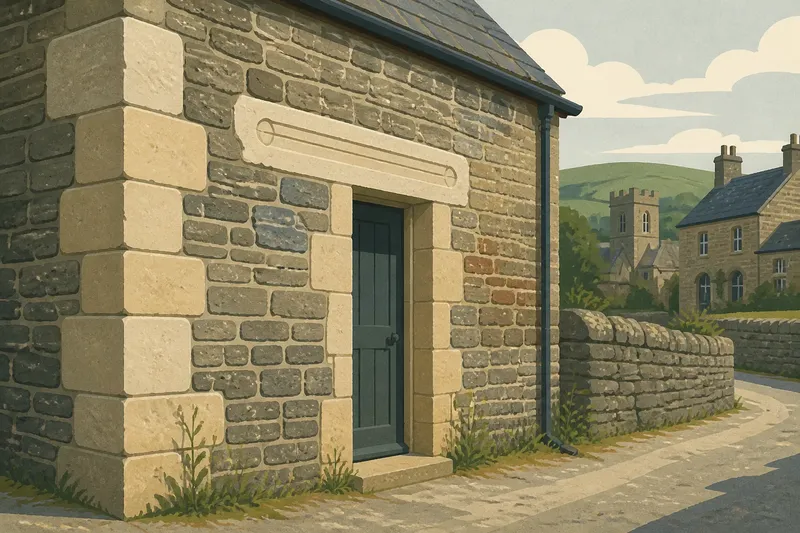
Where did that stone building’s materials come from? Local stone is a useful place to begin, but colour and texture cannot tell the whole story. A dressed doorway may sit in a rough older wall; a neat patch may use stone brought from elsewhere. To read local stone carefully, look at how it was worked, where it appears and how different parts meet.
Read the stone surface
Stone is not just a geological sample set into a wall. The same rock can look markedly different after quarrying, splitting, chiselling or weathering. A clean face may reflect skilled finishing rather than a different source. Conversely, stones from separate places can share similar colours once rain and lichen soften their surfaces.
Stand back first. Notice whether the wall is made from regular blocks, uneven pieces, thin courses or a mixture. Then look closer at a sheltered spot, such as beneath an eave or inside a deep doorway, where the face may be less worn. Ask what the masonry pattern suggests about building work, rather than deciding immediately what it says about the stone’s origin.
Tool marks offer clues, but not a simple date or place label. A squared block might have been cut nearby, transported from a quarry or salvaged from an earlier structure. A rough face may be deliberate, especially where the wall was meant to be covered or where speed mattered. The useful observation is the contrast: which stones received attention, and which were left uneven?
Separate finish from source
Builders could choose different finishes for practical and visual reasons. A finely dressed block might frame a window while less regular rubble fills the wall around it. A smooth plinth at the base may meet coarser masonry above. These changes can mark a boundary between functions, phases of construction or budgets, not necessarily between sources of stone.
Look at corners, openings and wall edges. Large, carefully shaped stones may be concentrated at quoins—the stones that form a building’s external corner—or around door and window frames. Their placement can make the whole façade seem more uniform than it really is. The infill between them may contain smaller pieces, varied colours and a different laying pattern.
Mortar matters to the reading, too. A fresh pointing repair can make old stone look newly assembled, while eroded joints can exaggerate a wall’s roughness. Different mortar colours or textures may help distinguish repair work from older masonry, but a change in appearance alone is not enough to establish a precise building sequence. Notice where the mortar changes, and whether that change follows a seam, an opening or an entire face.
Notice reused blocks
Stone is durable, which makes it an obvious candidate for reuse. When a building is altered or dismantled, sound blocks may be carried to another site or rearranged within the same one. Reused stone can retain traces of an earlier purpose: a worked groove, a bevel, a curve that seems out of place, or a face smoother than its neighbours.
Do not treat one unusual block as proof of a vanished building. It may have been cut for this wall, or its odd shape may suit a hidden joint. Look for a cluster of mismatches instead. A reversed carved face, a blocked opening and stones laid in an inconsistent direction make a stronger case that material has been moved or turned around.
Say you are looking at a village hall with a coarse wall and a polished block above its side door. The block has a shallow groove that does not line up with the doorway. You note that it is more finely worked, faces a different direction and sits within a patch of masonry that appears distinct from the surrounding wall. Those observations make reuse a reasonable possibility, but they do not identify where the block came from.
Salvage can also blur the boundary between local and imported stone. A block brought from a nearby demolished house may be local to the village but not native to the hall’s original construction. “Local” might mean quarried in the county, recovered from a neighbouring building or simply familiar in surrounding streets. Say which meaning you intend, and keep the claim proportionate to the evidence.
Trace repairs and changes
Buildings keep changing. A damaged corner might receive replacement blocks; a window may be narrowed, widened or blocked; a porch may be added in a different stone. These changes can create a patchwork that reflects maintenance and adaptation rather than a single building campaign.
Read the joins. A straight seam running down a wall may mark an addition. A change in course height around an opening can point to alteration. Freshly cut edges beside weathered stone may indicate replacement, though the contrast can also arise from different exposure to rain and sun. Shaded surfaces may age differently from those facing open weather.
Compare more than one side of the building. A front façade may have been carefully repaired or upgraded, while a yard wall preserves rougher work. If the same type of stone appears in a new porch but the joints and block sizes differ from the main building, describe that difference before trying to explain it. The façade is evidence of a decision; it does not automatically identify the quarry.
For public buildings, churches and listed properties, avoid touching or scraping stone to inspect it. Keep to public paths and rely on visible features. Any work to a protected building or a repair involving uncertain materials should be discussed with the relevant conservation professional; local designation and material guidance can differ.
What can local stone tell you?
Can colour identify local stone?
Colour can help you compare a building with nearby structures and exposed rock, but it cannot settle the source by itself. Weathering, damp, soot, lichen and surface finish all alter how stone looks.
Does a rough wall mean an old building?
Not on its own. Rough masonry may be an original choice, a later repair or a wall built with stone gathered from more than one source.
How can reused stone be recognised?
Look for features that seem out of place, such as a carved face turned sideways or a groove that serves no visible purpose. Several mismatches together make reuse more plausible, but they may still leave the stone’s previous location unknown.
Can mortar reveal a building phase?
A change in mortar can help you spot a repair or a change in technique, especially when it follows a clear seam. It is a clue to record, not a dependable date stamp.
Make field notes useful
Once you have looked over the wall, turn what you noticed into a record another person could check. Write down where you stood, which face you examined and what was visible. A phone photograph can help you compare details later, but include the whole wall as well as close views so the stone’s position is not lost.
- Check which wall face you examined and how exposed it is; if it is sheltered, note that weathering may differ, and if it faces open weather, avoid treating its surface as a direct guide to source.
- Check the stone’s shape, size and visible finish; if blocks are regular and dressed, record that pattern, and if they are irregular, describe the rubble rather than calling it old.
- Check where courses, mortar or colour change; if the change follows a seam or opening, note a possible alteration, and if it covers the whole face, record the broader difference without assigning a cause.
- Check for unusual grooves, mouldings or reversed faces; if several features seem out of place, record possible reuse, and if only one stands out, leave its purpose open.
- Check whether the same stone appears elsewhere nearby; if it does, compare its finish and placement, and if it does not, avoid claiming a local source from appearance alone.
- Check whether a statement is something you saw or an explanation; if it is visible, write it as an observation, and if it is an interpretation, mark it as a possibility.
What is not worth the effort? Guessing a quarry from colour alone, or assigning a precise age to a wall from one tool mark. Those shortcuts can turn a useful observation into an unsupported claim.
Imagine a visitor examining a stone building beside a churchyard wall and a former mill. They write down that the building’s front corner has large squared blocks, while the side wall uses smaller rubble and has a vertical seam beside the doorway. They compare the nearby structures and see similar-looking stone in different finishes, but no clear match for the seam. The resulting note is specific: the materials look related, while the seam may mark an alteration; the quarry and the timing remain unknown.
That is the more useful way to read local stone: treat it as part of a building’s changing fabric, not a label for its birthplace. Finish, reuse and later additions can reveal how people shaped and maintained a place, even when the visible rock cannot settle where it began.