The Clues Left Behind in a County Place Name
Trace a county place name through old spellings, local speech and landscape to separate useful evidence from an appealing but unsupported origin story.
What can a county place name tell you, and how can you tell a useful clue from a tempting guess? A county place name may preserve hints about landscape, language and settlement, but its present spelling rarely tells the whole story. Give one name a week of gentle investigation, and you can build a careful account of what is known and what remains open.
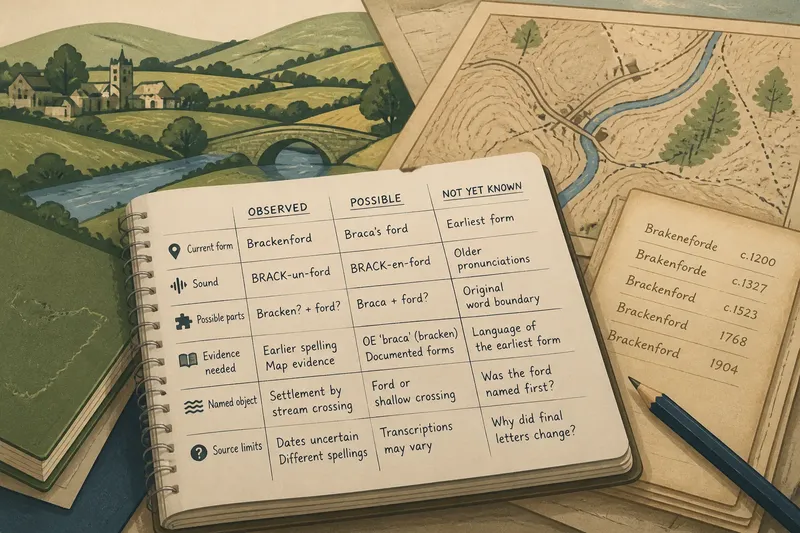
The aim is not to solve every name. It is to notice how its parts and spellings behave, then check those clues against the place itself. Keep a notebook or document with three headings: “observed”, “possible” and “not yet known”. That small separation helps you enjoy a promising idea without quietly turning it into fact.
Choose one name
Begin with one village, hamlet, farm or natural feature in your county. A compact subject is easier to follow than a long list, and a familiar place gives you something concrete to compare with the words on the page.
Write down the current official form, including spaces, hyphens and punctuation. Note where you saw it: on a road sign, local map, council page or printed guide. Forms may differ slightly, so record them rather than choosing whichever looks most appealing.
Note what kind of place the name identifies. A settlement name may have a different history from one attached to a stream, hill or district. If the same wording appears for nearby features, record that relationship as a question, not an answer.
For this first pass, avoid searching for a single “meaning”. Online name lists can be useful leads, but a short gloss without evidence is only a starting point. Save the page or write down its exact claim and source, so you can later distinguish it from your own observations.
Listen before parsing
Say the name aloud, then listen to a local speaker if the opportunity arises naturally. A spoken form can preserve sounds that the standard spelling hides, or reveal that a familiar-looking word is pronounced in a less obvious way. One person’s pronunciation is not a final authority; speech varies between households and neighbouring places.
Break the written form into possible parts, but keep those divisions provisional. A beginning or ending may resemble a known word element, yet resemblance alone does not establish a shared origin. Older spellings can show whether a proposed division has support or whether the modern form has obscured a different arrangement.
Make a small table in your notes:
- Current form: record the spelling used now; if signs and maps differ, keep both forms and note their sources.
- Sound: write down a pronunciation you hear; if speakers differ, record the variation rather than choosing one as definitive.
- Possible parts: mark tentative divisions with a question mark; if no division fits securely, leave the name whole.
- Evidence needed: list an earlier spelling, a documented language form or a relevant local feature; if none is available, keep the proposed origin unresolved.
- Named object: identify whether the name belongs to a settlement, stream or other feature; if the object is unclear, check a reliable map before interpreting it.
- Source limits: note missing dates, uncertain transcriptions or unexplained glosses; if a source lacks context, use it only as a lead and seek a better-documented reference.
This is more useful than writing a neat translation too early. It leaves room for names to change shape over time and for apparent word parts to mislead.
Trace the spellings
On the second and third days, look for earlier forms in sources that preserve names as they were written at different times. Local history books, county record catalogues, old maps and place-name reference works may point towards useful material. A library catalogue or local archive guide can help you identify what exists without requiring a visit straight away.
Record each spelling with its source and the date or period given there, if available. Copy the form carefully; do not silently regularise unfamiliar letters. If a source gives only a transcription or an uncertain date, note that beside the entry. A sequence of forms can be more illuminating than a confident modern gloss, but it is only as dependable as the source details attached to it.
Compare changes one at a time. Ask whether a consonant appears or disappears, whether a vowel shifts, or whether the word boundary seems to move. A clerk, mapmaker or printer may have represented a local sound in a way that made sense to them, and a later spelling may have become standard. Treat that as a possibility to investigate, not an automatic explanation for every difference.
It is not worth spending hours trying to force every letter into a tidy story. If the available forms do not support a proposed change, mark it as uncertain and move on. A modest note about the limits of the evidence is better than a polished but unsupported origin.
Check the setting
On the fourth day, look at the place around the name. Use a local map, a public footpath map or a visit from a suitable public route. Notice visible features that might matter: a stream, slope, crossing, cluster of older buildings or distinction between nearby settlements. Record what you can see without assuming the landscape has remained unchanged since the name formed.
Look at neighbouring names as well. A recurring element across a small area may suggest a shared naming pattern, while a name that stands alone might have a different explanation. Nearby examples are comparisons, not proof; they can help you ask sharper questions about language and geography.
Imagine you are examining a fictional county village called “Brackenford”. You note a present-day stream crossing near the village, then find an older map spelling that differs in its final letters. First, record the crossing as an observation. Next, compare the older form with a dependable place-name reference and ask whether it supports an element associated with a ford. If it does not, leave the crossing as a landscape clue without claiming it explains the name; if it does, describe the reading as supported by that evidence, while noting any remaining uncertainty. The result is a clear distinction between what the map shows and what the name evidence can establish.
For a settlement name, consider whether it may once have referred to a nearby feature rather than the settlement as a whole. A stream name can outlast changes in a village’s layout, and a farm name may spread to a wider area. Keep the named object and the feature it might describe separate until evidence links them.
Weigh each clue
By the fifth day, sort your notes into three levels. “Documented” belongs to information directly supported by a source, such as an earlier recorded form. “Plausible” describes an interpretation that fits some evidence but is not established. “Unknown” covers gaps you cannot responsibly fill from the material at hand.
Test each proposed reading against the same questions:
- If the proposed word element resembles the recorded forms, keep it under consideration; if it matches only the modern spelling, treat it as a weak lead and look for earlier evidence.
- If a dependable source supports the suggested language or naming pattern locally, record that support; if not, leave the language claim open and seek a specialist reference.
- If the sound or spelling changes have a plausible explanation, note it; if the reading requires several unsupported changes, set it aside or mark it as highly uncertain.
- If a landscape clue fits the named feature, record the fit as context; if it depends on assuming the landscape has not changed, do not use it as proof.
- If a competing explanation fits the evidence just as well, preserve both readings; if one has stronger documentary support, explain that difference rather than hiding the alternative.
- If a source provides a clear form and date or period, cite those details in your notes; if the source is undated or unclear, label it accordingly and look for corroboration.
If an interpretation depends on a chain of assumptions, say so plainly. A name may look as though it contains a word for a hill, yet early forms may not preserve the necessary sound. The nearby rise makes the suggestion attractive, but “possible” remains the sensible label.
Questions about place names?
Can a modern spelling reveal a place name’s origin?
It can offer a lead, but later changes in pronunciation, spelling or word boundaries may have altered its appearance. Compare it with recorded earlier forms before treating an apparent word as evidence.
Where can I look for older place-name spellings?
Try local history publications, old maps, county record catalogues, library collections and specialist place-name references. Keep the source and any date attached to each form, because an isolated spelling is difficult to assess.
Should I trust a place-name meaning printed on a local sign?
Use it as a clue about local interpretation, not as proof by itself. Look for the evidence behind the explanation, especially earlier spellings and a clear account of how the proposed elements fit them.
What if two explanations both seem possible?
Record both and compare how well each fits the spelling history, pronunciation and setting. If neither has stronger support, leave the origin unresolved rather than choosing the more pleasing story.
Write a careful account
On the sixth day, write a short account that separates observation from interpretation. You might say that a modern form resembles a particular word element, that an earlier spelling offers some support, and that the connection to a nearby feature remains uncertain. Name your sources in ordinary prose or keep a simple source list for anyone who wants to follow the trail.
Avoid turning an uncertain suggestion into a colourful local legend. If you share the account with a local group or on a noticeboard, describe the strength of the evidence in familiar terms: “recorded in”, “may derive from” or “one possible reading”. Those phrases help readers understand that a place name can preserve a clue without delivering a complete answer.
On the seventh day, revisit your notes and remove anything that has become a claim without support. Leave yourself one next question if a useful gap remains, such as locating a clearer map copy or checking a specialist reference. The best account of a county place name is not always the one with the neatest translation; it is often the one that lets the spelling history, local setting and remaining uncertainty sit honestly together.
That is the lasting value of a careful reading: the name becomes a way to ask better questions about the county, rather than a label forced to explain it all. When you encounter another county place name, carry over the same patience, not the same assumed answer.